
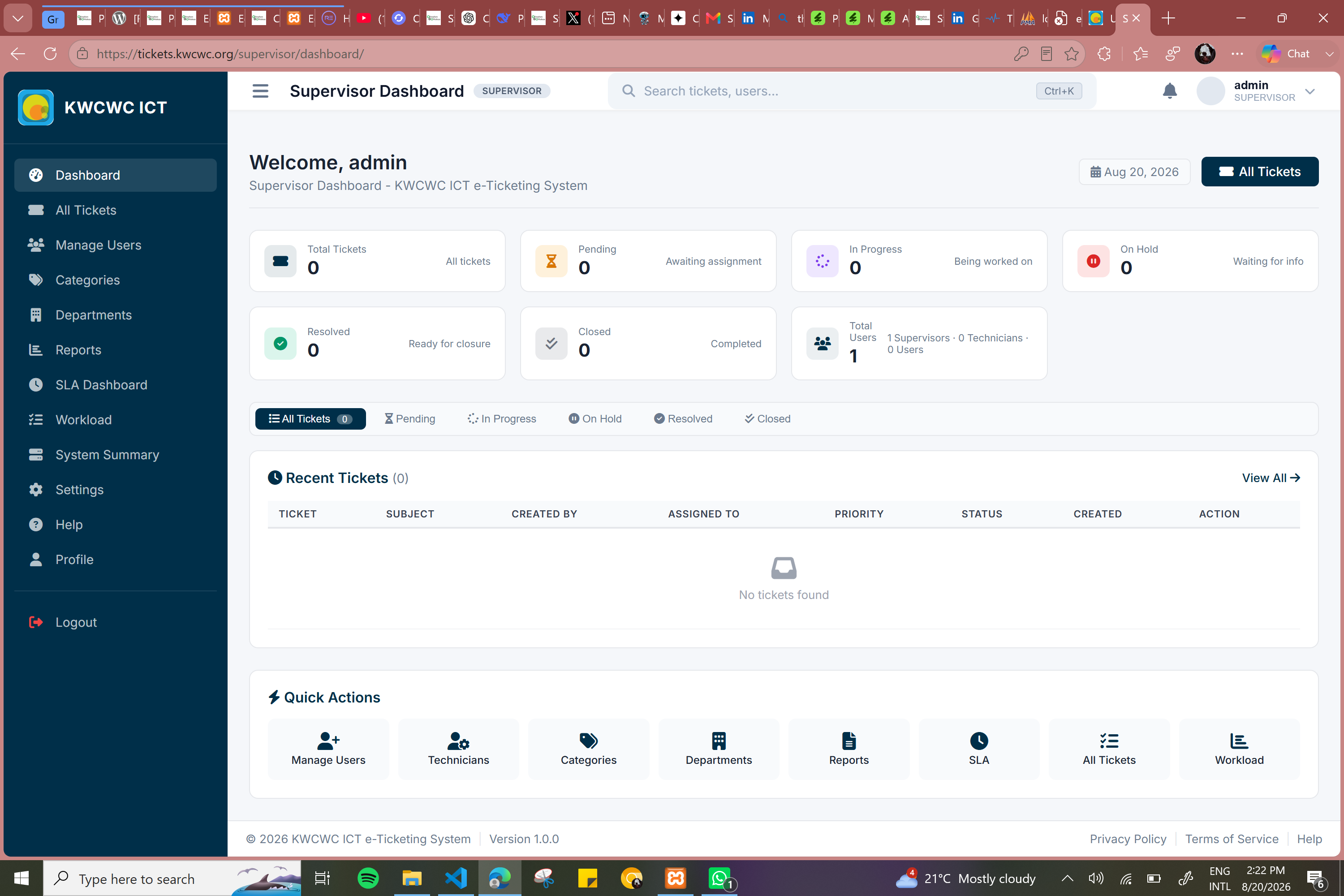
The KWCWC E-Ticketing System is a complete ICT helpdesk platform I built to automate the reporting, assignment, tracking, escalation, and resolution of technical support requests. The system serves three user types — End Users, Technicians, and Supervisors — and features a full ticket lifecycle, SLA monitoring, real-time notifications, a knowledge base, email alerts, reporting dashboards, and audit logging. It was built with Django, Python, MySQL, WebSockets, Celery, and Redis, and is deployed on a live VPS server. Strategy I built a complete helpdesk platform with role-based access control for three user types — End Users who submit tickets, Technicians who resolve issues, and Supervisors who manage workflow and monitor SLA compliance. I implemented a full ticket lifecycle management system from creation through assignment, progress tracking, resolution, and closure. I integrated automated SLA tracking to monitor response and resolution times with automatic escalation when deadlines are breached. I built WebSocket-powered real-time notifications and dashboards for live updates. I created a self-service knowledge base, automated email alerts for ticket updates and feedback surveys, comprehensive reporting dashboards, and complete audit logging for transparency. Design I built the system using Django as the web framework with Django REST Framework for API development. I implemented WebSockets for real-time communication and used Celery with Redis for task queuing and background jobs. I used MySQL as the production database and implemented JWT authentication for secure API access. For deployment, I set up and managed a VPS running Linux with full server configuration. The frontend uses Django Templates with JavaScript for dynamic features. Features Role-Based Access Ticket Lifecycle Management SLA Monitoring Real-Time Updates Email Notifications Reporting & Audit Logging As the Full-Stack Developer, I designed and implemented the complete Django application, built the database schema with MySQL, developed role-based access control, implemented WebSocket real-time communication, created dashboards for all user roles, designed the email notification system, built reporting and analytics features, and deployed the system to production. Understanding Brief The Solution My Role Before this system, ICT support requests at KWCWC were handled manually through phone calls, emails, and walk-ins. There was no central system to track requests, leading to lost tickets, delayed responses, and no visibility into workload or performance. I developed a Django-based helpdesk system that automates the entire support process — from ticket creation through assignment, resolution, and closure. The system provides real-time visibility, automated notifications, and complete audit trails. As the Full-Stack Developer, I was responsible for designing, building, and deploying the entire KWCWC E-Ticketing System. I worked on both the backend and frontend to create a complete, functional helpdesk platform. I designed the database schema, built the Django backend with all business logic and APIs, and developed the frontend interfaces using Django Templates and JavaScript. I implemented role-based access control for users, technicians, and supervisors, integrated WebSocket-powered real-time notifications, and configured Celery with Redis for automated tasks like SLA escalation and email alerts. I also set up the production environment, deployed the system to a live VPS server, and ensured the platform was secure, responsive, and fully functional for daily use. Before this system, ICT support requests were handled manually through phone calls, emails, and walk-ins — leading to lost tickets and delayed responses. I built a centralized Django-based helpdesk system that automates ticket creation, assignment, tracking, and resolution, with role-based access and SLA monitoring.
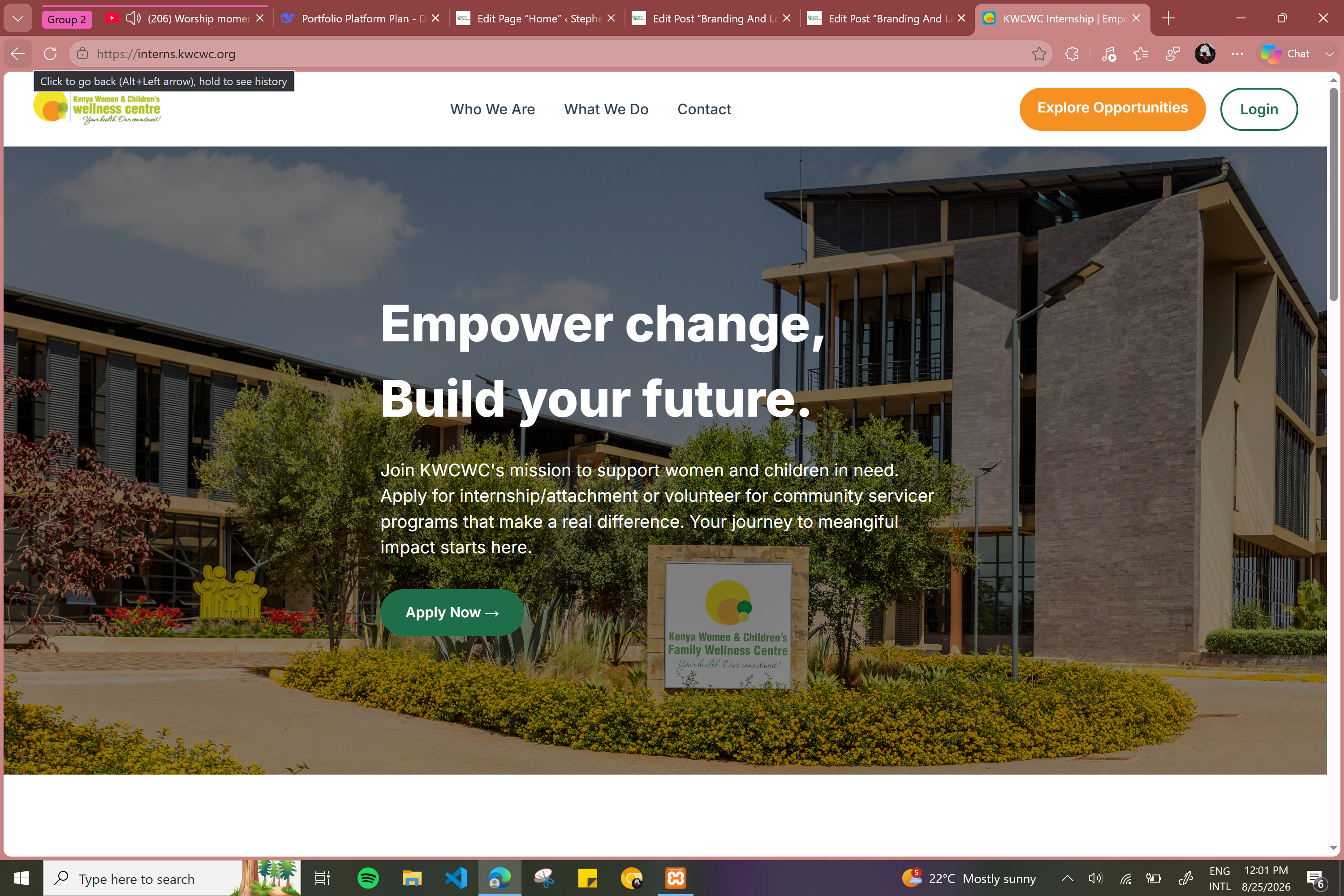
KWCWC Internship Management System
The organization needed a centralized platform where students could easily apply online and administrators could manage the entire application process efficiently. Key requirements included an online application form, program management for internships and attachments, application tracking, and a public-facing information hub. Strategy I built a complete internship management platform for KWCWC that allows students to apply for internships, attachments, and community service programs online. The system streamlines the entire application process — from submission to program placement — while providing the organization with a centralized way to manage applicants and track participation. The platform supports KWCWC’s mission of empowering women and children through skills training, ICT development, and community service programs. Design I developed the system using Django as the web framework with Python for backend logic. The frontend uses Django Templates with HTML, CSS, and JavaScript for a clean, user-friendly interface. MySQL serves as the production database, storing applicant information, program details, and application records. The system is deployed on a live server and accessible at interns.kwcwc.org. Features Online Application Portal — Students can apply for internships and attachments directly Program Management — Manage internship, attachment, and community service programs Application Tracking — Track application status from submission to placement Youth Training & ICT Focus — Supports skills training and healthcare system building Contact & Information Hub — Provides organization details and application guidance As the Full-Stack Developer, I designed and implemented the complete Django application, built the database schema with MySQL, developed the frontend interface using Django Templates and JavaScript, integrated the application submission workflow, and deployed the system to production at interns.kwcwc.org. Understanding Brief Solution My Role The organization needed a centralized platform where students could easily apply online and administrators could manage the entire application process efficiently. Key requirements included an online application form, program management for internships and attachments, application tracking, and a public-facing information hub. A key challenge was designing an intuitive application form that captures all necessary information while remaining user-friendly. I solved this by creating a clean, step-by-step form with clear validation and guidance. Another challenge was ensuring the system could handle multiple program types — internships, attachments, and community service — each with different requirements. I built a flexible program management system that allows administrators to create and manage different program types with custom fields. As the Full-Stack Developer, I designed and implemented the complete Django application, built the database schema with MySQL, developed the frontend interface using Django Templates and JavaScript, integrated the application submission workflow, and deployed the system to production at interns.kwcwc.org. Students can apply online, administrators can manage applications and programs in one place, and applicants can track their status in real-time. The system solved the problems of lost applications, manual tracking, and lack of visibility, making the entire process efficient and transparent.
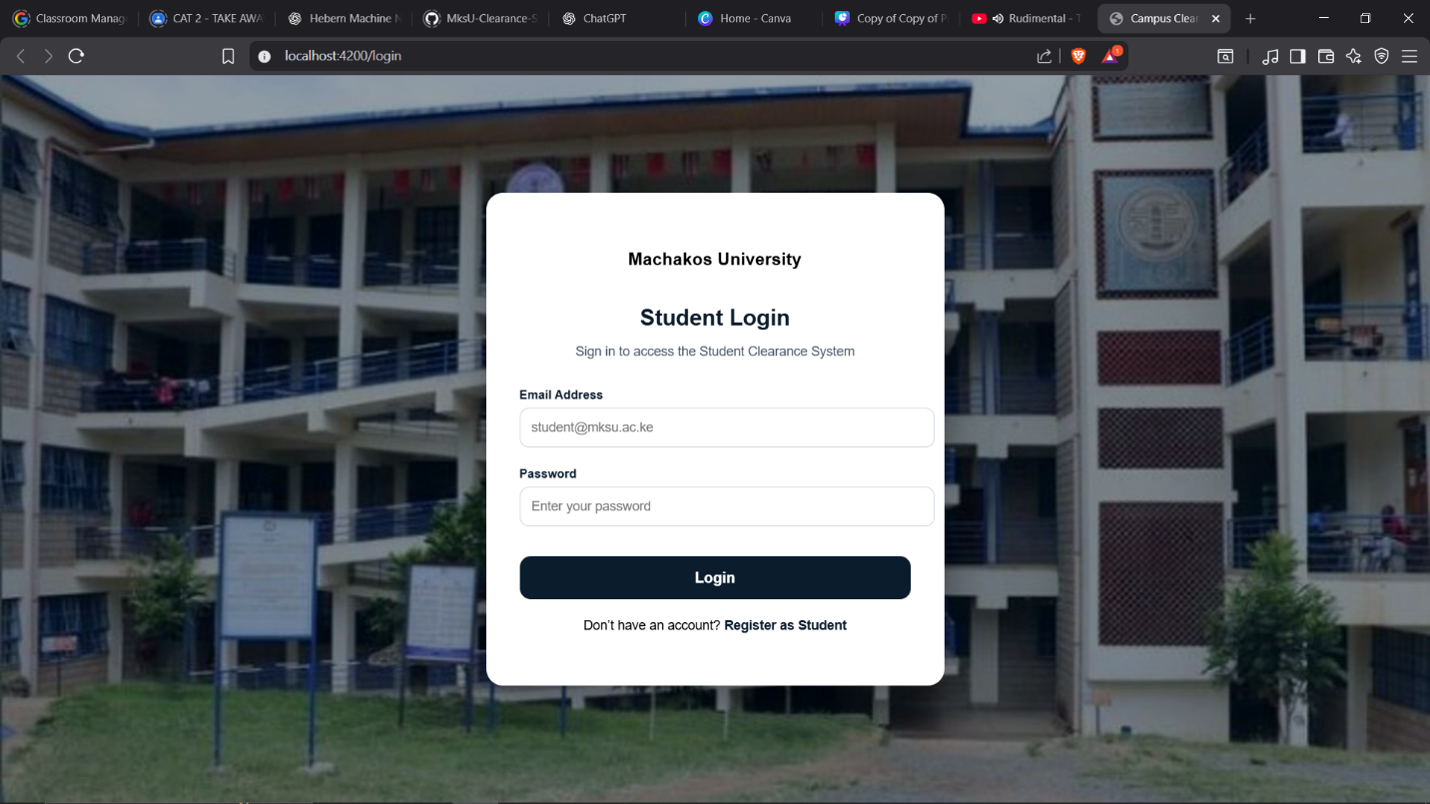
MkSU Digital Graduation & Clearance System
The MKSU Digital Graduation & Clearance System is a web-based platform I built to digitize and automate the entire graduation clearance process at Machakos University. Before this system, students had to physically visit multiple departments — Finance, Library, COD, Mess, Hostels, Workshops, and Sports & Games — to obtain stamps, leading to long queues, repeated campus visits, and clearance periods lasting weeks. There was no centralized system to track progress, documents were easily lost, and staff spent significant time on repetitive manual verification instead of higher-value work. I built a centralized, role-based platform where students can initiate and track their clearance online, departmental staff can digitally approve or reject requests, and administrators have full oversight with reporting and audit trails. The system uses Django for the backend, Angular for the frontend, MySQL for the database, and integrates with university credentials for authentication. It eliminates paper-based forms, provides real-time visibility for all users, reduces clearance time from weeks to days, and ensures accountability through digital approval trails and audit logs. Strategy The goal was to eliminate the manual, paper-based clearance process at Machakos University. Students had to physically visit multiple departments to get stamps — Finance, Library, COD, Mess, Hostels, Workshops, and Sports & Games — resulting in long queues, repeated campus visits, and clearance taking weeks. The strategy was to build a centralized digital platform that automates the entire clearance lifecycle, allowing students to complete everything online, staff to approve or reject with one click, and administrators to oversee the entire process with real-time visibility and audit trails. This would reduce clearance time from weeks to days, eliminate lost documents, and provide full accountability through digital logs. Design I designed the system with a role-based architecture serving three user types — Students who initiate and track their clearance, Departmental Staff who review and approve requests, and Administrators who oversee the entire process with reporting capabilities. The backend was built using Django with a MySQL database for secure data storage. The frontend was built with Angular for a dynamic, responsive user experience. Authentication is handled through university credentials. The student portal provides a real-time dashboard showing clearance progress across all departments. Departmental staff have a dedicated interface to view pending requests and approve or reject them with one click. The admin dashboard provides full oversight with reporting and system governance features. Features Student Portal — Initiate and track clearance in real-time Departmental Dashboards — One-click approvals and rejections Admin Dashboard — Oversight, reporting, and system governance Role-Based Access — Students, staff, and administrators Secure Authentication — University SSO integration The backend was built using Django, a Python web framework that provided the foundation for the system’s API, business logic, and database operations. MySQL was used as the relational database to store student records, departmental approvals, and clearance data securely. The frontend was developed using Angular, a TypeScript-based framework that enabled a dynamic, responsive, and interactive user experience. HTML, CSS, and JavaScript were used to structure, style, and add functionality to the student, departmental, and admin interfaces. Authentication was implemented using university credentials, ensuring secure access for all users. Understanding Brief Solution My Role Before this system, graduation clearance at Machakos University was entirely manual. Students had to visit multiple departments physically to get stamps, often taking weeks to complete the process. There was no centralized tracking, documents were frequently lost, and staff were burdened with repetitive verification tasks. The university needed a digital solution to eliminate paperwork, reduce clearance time, and provide real-time visibility. I built a Django and Angular-based platform that digitizes the entire clearance lifecycle — from student initiation through departmental approvals to final clearance — with role-based access, real-time tracking, and complete audit trails. This system offered a complete digital alternative to the manual graduation clearance process at Machakos University. Students could initiate and track clearance online, staff could approve or reject with one click, and administrators had full oversight with audit trails. As the Frontend Developer, I built the student dashboard, departmental interfaces, and admin panel using Angular, integrated them with the Django backend APIs, and ensured a responsive, user-friendly experience. The system was fully functional and demonstrated during the Hackfest competition. As the Frontend Developer, I was responsible for designing and implementing the complete user interface for the MKSU Clearance System. I built the Student Portal with a real-time dashboard for tracking clearance progress, the Departmental Staff interfaces for viewing and approving requests, and the Admin Dashboard for oversight and reporting. I worked with Angular to create dynamic, responsive components, integrated the frontend with the Django backend APIs, implemented form validation and error handling, and ensured the entire system was accessible and user-friendly across all devices. This system was developed as a team entry for the Machakos University Hackfest competition. I worked as part of a team to build the complete digital clearance system. My primary responsibility was the frontend development — building the Student Portal, Departmental Staff interfaces, and Admin Dashboard using Angular, TypeScript, HTML, CSS, and JavaScript. The backend was handled by other team members using Django and MySQL. The project was fully built and demonstrated as a working prototype, though it was not deployed to production.